
Contents
Travel archive: These personal observations were written during Myanmar’s early-2010s tourism boom, following the country’s political opening. They document the experience of travel at the time, not present-day safety or access. Conditions have changed profoundly since the 2021 military coup and subsequent conflict. Check the UK’s official Myanmar travel advice before considering a visit.
Travelling through Myanmar during its tourism boom: Beyond the famous pagodas of Bagan, the ancient towns around Mandalay and the street life of Yangon, what stayed with me was ordinary everyday life: monasteries, markets, food, villages and local curiosity. These are the encounters I remember from a very different period in Myanmar’s history.
Myanmar’s Tourism Boom After the 2011–2012 Opening
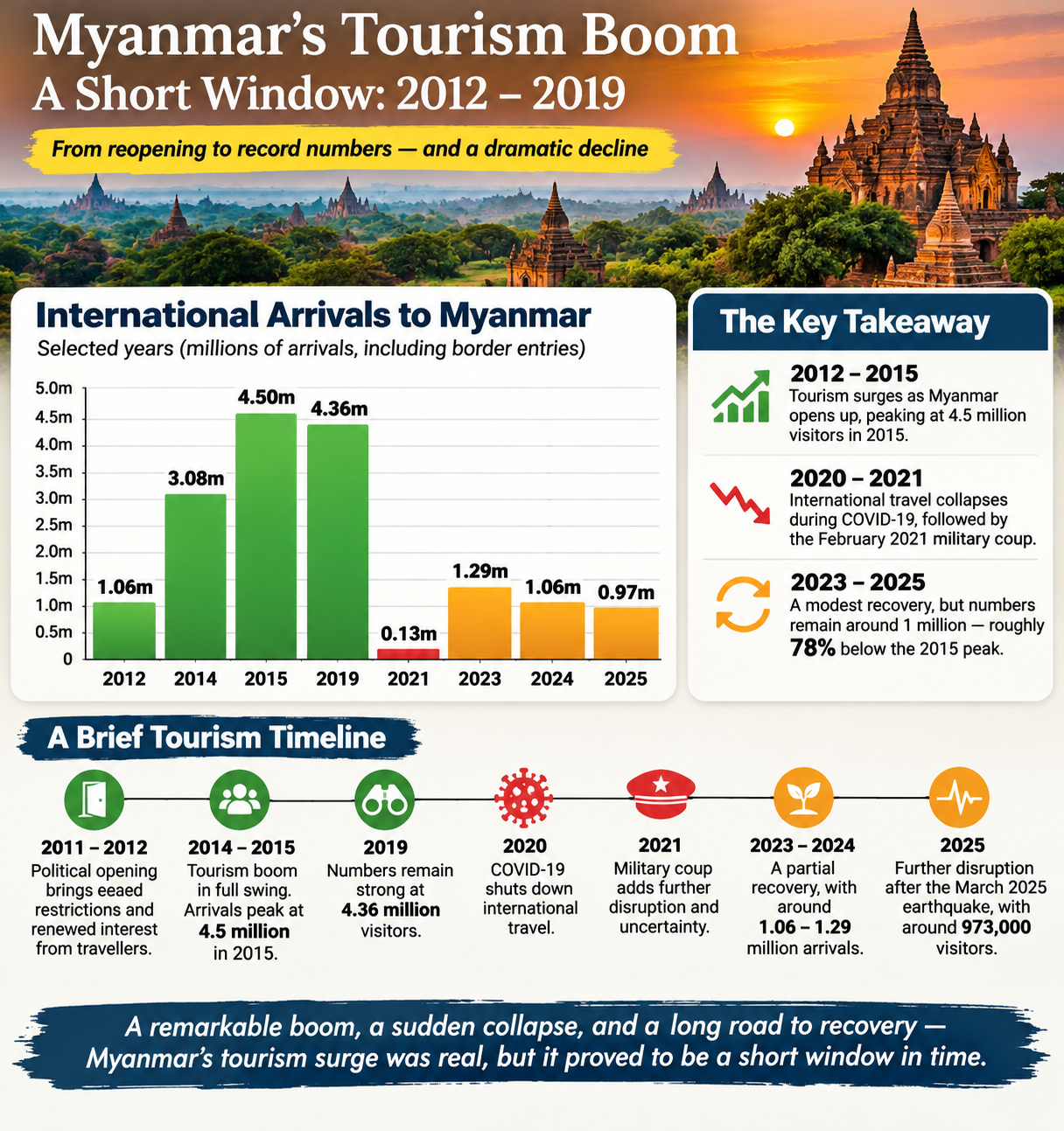
Myanmar had never been entirely closed to visitors, but political and economic reforms starting in 2011 brought a surge of tourism and international attention. The country’s Tourism Master Plan and official tourism statistics record around 816,000 international arrivals in 2011, 1.06 million in 2012, 2.04 million in 2013 and 3.08 million in 2014. These totals include border arrivals, not solely holidaymakers, but they show the extraordinary pace of change.
The Short Window of Myanmar’s Tourism Boom
In hindsight, this was a remarkably short window of booming tourism. International arrivals climbed to roughly 4.5 million in 2015 and remained high at about 4.36 million in 2019. Then the COVID-19 pandemic brought international travel almost to a standstill. The February 2021 military coup and ensuing conflict made a recovery far more difficult, and the devastating March 2025 earthquake brought further disruption.
Myanmar recorded only around 130,000 international arrivals in 2021. There was a partial recovery to approximately 1.29 million in 2023, followed by 1.06 million in 2024 and about 973,000 in 2025: roughly 78% below the 2015 peak. These totals cover international arrivals, including border crossings, rather than only leisure tourists. The figures come from Myanmar’s Ministry of Hotels and Tourism’s 2024 inbound report and reporting on the 2025 totals published in July 2026.
It puts the excitement and panic of the early 2010s into perspective. When everyone was rushing to see Burma before it changed, few could have imagined how quickly that period of relative openness would end. The following observations are how I experienced the tourism boom while it was happening.
For many this post will seem two years too late but for me the best time to visit a destination is when it’s not being over hyped by every travel magazine and headline across the world. While 2012 and 2013 may have been the best years for Myanmar tourism this by no way means they were the best years to visit… and in many ways they proved the opposite.
Travellers panic ‘Man, you need to see Burma now… before it’s too late’ with expectations of Starbucks and Krusty Clown burgers popping up overnight. The tourism infrastructure fails to cope; tourists arrive with bags full of dollars, they bumble through the most menial of tasks and bang on doors of fully booked hotels.
In honesty I can’t think of a worse time to be in Myanmar. My travels through Bagan, Mandalay and Yangon told a more personal story.


How the Tourism Boom Changed Travel in Myanmar
For me the best years were before 2012, few tourists and when exploration was still relatively raw and exciting. Then there is post-2013 once mass tourism has pushed through initial teething. By the time of our visit, travel felt a lot less stressful and the initial hysteria seemed to have calmed.
I touch down in Mandalay, withdraw local Kyat from a choice of airport ATMs, travel the free AirAsia shuttle bus to Mandalay city centre and speedily check-in to my pre-booked hotel suite. Are these the conveniences which are ruining travel in Myanmar? Truth is Myanmar has always been open to tourists yet few bothered to visit until travel companies pushed them too.


Meeting Local People During Myanmar’s Tourism Boom
At the time, Myanmar was changing quickly, and I wondered how long these encounters would remain the same. For me the most precious part of travel in Myanmar was the intrigue of locals which is still there, even in the tourist areas. Unfortunately as more of us obnoxious travellers pass through this intrigue will no doubt fade, tourists will become ‘everyday’ and the smile of locals will be increasingly forced.
The uglier traits of tourism will also likely surface, the tourist dollar attracting opportunism, greed and in worse cases crime and sleaze.


Experiencing Everyday Life Beyond Myanmar’s Tourist Trail
Beyond the headline attractions, my favourite memories were of small encounters, unfamiliar food and everyday life along the Irrawaddy River.
However, relative to the rest of Southeast Asia, Myanmar is a new travel destination, turn up in some sleepy backwater and chances are you’ll be poked with a stick. Truth is you can get off the beaten track in any country, even in Bangkok a quick taxi finds me in foreigner free locations.
Back then, I found it easy to escape the tourist crowds and experience everyday life away from the best-known attractions. That was my experience at the time, not a suggestion to travel into restricted areas today. Note, Vietnam saw it’s McDonald’s in 2013 and they’ve been flirting with tourists for decades.


Agree that locals will eventually lose that initial ‘novelty’ they have of tourists. But I think Myanmar’s people are naturally friendly (and not hardened and desensitised like some of the population centres in industrialised nations). There is a great article that may be of some interest, which goes over Burma’s history and culture in more depth http://www.travelindochina.com/blog-articles/welcome-to-burma/
I really like to visit Myanmar for once. Its a very great place for travel either with friends or family. I got many ideas after reading this blog. Keep sharing.