
Contents
Most adventures I write about on this blog involve movement: trains through Laos, overnight buses in Vietnam, ridgeline trails somewhere with no phone signal. Movement feels like progress to me.
But some of the most rewarding outdoor experiences ask something completely different of you. They ask you to stop, settle into one spot, and let the world come to you.
Spring turkey hunting belongs to that rare category. It is slow, deliberate, and entirely dependent on your ability to stay still and alert for hours at a stretch. It also quietly exposed a gap in my outdoor kit that I never saw coming, one that no hiking gear guide had ever thought to mention.


The Gear Problem Nobody Warns You About
Pack for a three-hour sit in pre-dawn woods and you learn fast that ultralight hiking logic has real limits. The minimalist approach that works beautifully on a trail falls apart completely when you are pressed against a tree trunk on uneven ground, unable to shift your weight without making a sound.
Cold seeps through wet leaves within minutes. Rocky soil finds every pressure point your body has. Your lower back begins to protest around the ninety-minute mark. You start making tiny unconscious adjustments, and those small movements are precisely what ends a turkey hunt before it even begins.
Experienced hunters obsess over shotgun selection, calls, and camouflage patterns, then sit on an exposed root for four hours and wonder why they could not hold position at the critical moment. Discomfort is a focus tax, and it collects interest fast.
What a Kickstand Vest Actually Changes
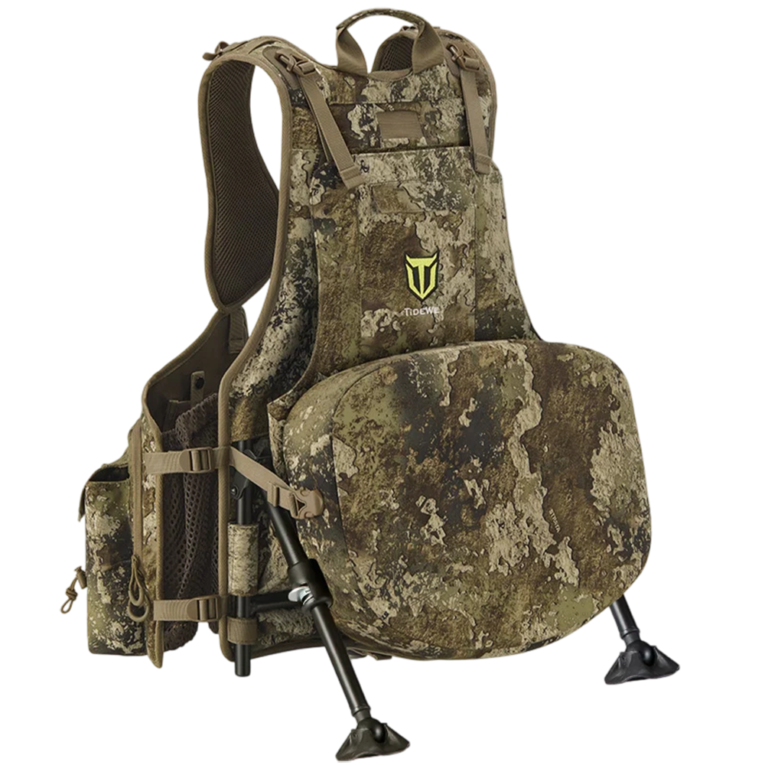
A kickstand turkey vest solves this problem at the source. The concept is straightforward: a rigid, foldable seat support is built directly into the vest, so you carry your seating with you and deploy it in seconds once you find your position.
It keeps you off cold or wet ground, raises your hips enough to relieve real strain on your lower back, and holds you stable on sloped, leaf-covered terrain that defeats a flat foam pad. Turkeys favour that difficult ground precisely because it is hard to approach without noise.
The gain is not comfort for its own sake. It is the ability to stay locked in position for as long as the situation requires, without your body working against your concentration.
Mobility Has to Match the Support
Here is a tension that cheaper vest designs get consistently wrong. A good hunting vest needs to sit well and walk well in equal measure. Spring turkey hunting is not a stationary pursuit. You set up, wait, call, and then need to move fast and quietly when a bird answers from an unexpected direction. Dead weight on your back changes how you cover ground.
The better lightweight turkey vest designs balance these two demands through thoughtful construction: load distributed evenly across your shoulders, a seat mechanism that folds flat and adds minimal bulk in transit, and fabric that does not broadcast your movement when you reposition. Getting both right in a single piece of kit is harder than it looks.
Why Fabric Choice Is Not a Minor Detail
Noise discipline separates productive hunting sessions from frustrating near-misses, and vest fabric plays a larger role in that than most people expect before their first serious sit. Stiff synthetic materials produce a faint but consistent rustle with every arm movement and body shift.
In open hardwood timber at first light, with a gobbler working closer at 60 yards, that sound carries further than you want to believe. Brushed, soft-faced fabrics eliminate it entirely. The distinction between a crinkle-prone synthetic and a quiet cotton-blend construction is not a minor specification on a product page. It is the actual sound your vest produces when you slowly reach for a call or adjust your grip on a shotgun during those final, critical seconds. Choose wrong and the fabric does the announcing for you.
Pocket Design Reveals Everything
How a vest organises its storage tells you more about its design quality than any other single feature. A poorly considered vest gives you many pockets. A well-designed one gives you the right pockets, positioned where you can reach them while seated and without looking.
A dedicated call pocket needs to be deep enough that a box call does not crack under pressure from the seat support. Water access should be manageable without standing. A license pocket should open quietly. Front storage for gloves, a face mask, and spare shells needs to sit in a consistent location that your hands learn through repetition.
That muscle memory matters more than it sounds. When a gobbler closes to within 40 yards and you need to make a quiet adjustment, your hands reach by habit. If you have to search, you have already moved too much.
Who Benefits Beyond Turkey Hunters
Turkey hunters are the obvious audience for this kind of setup, but they are far from the only ones who will recognise the problem it solves. Wildlife photographers doing long waits in fixed hides face the same physical challenge. Birders who practice stationary observation rather than constant movement benefit from the same stable support. Anyone who has sat in one position for two or three hours and discovered that stillness is its own physical discipline will understand exactly what is at stake.
First-time spring hunters in particular tend to underestimate how much sustained discomfort shapes early sessions. Removing that variable frees your attention for the things that actually take seasons to learn: reading bird behaviour, refining your calling, understanding how turkey movement shifts across the morning.
The Real Case for Getting This Right
I am not a gear-first person. Most of what I carry in the field is older, repaired, and bought without paying retail. But through enough trips, you develop a reliable sense for the difference between equipment that flatters your image and equipment that quietly removes friction from the experience itself.
A vest with proper sitting support, balanced weight distribution, and well-positioned pockets belongs firmly in the second category. It does not make you a more skilled hunter or a more patient observer on its own. What it does is stop your body from becoming the obstacle between you and the moment you came for.
That is the gear worth spending on: not the pieces you notice, but the ones you stop noticing because they simply do their job without interruption.