
After touching down at Osaka’s Kansai International Airport, we connect directly by train to JR Tennoji Station and find ourselves at the doorstep of the renowned Abeno Harukas building in Osaka. With twelve days of travel and uncertainty ahead, we’ve decided to make the most of our first days here with two nights at the iconic Osaka Marriott Miyako Hotel, situated on the top floors of the building.
The elevator shuttles us to the reception on the 19th floor, where we step into towering spaces and floor-to-ceiling windows overlooking the tops of the surrounding high-rise skyline. The lobby feels more like a futuristic sci-fi skyport than any typical urban lodging—yet we’re still only a third of the way up the Abeno Harukas building, famously the tallest not only in Osaka but in all of Japan.
After checking in, we rocket up in another elevator to our 53rd-floor guest suite high above the city. To put the height into perspective, the observation deck—one of the city’s main attractions—is just seven stories above us, on the 60th floor. As part of our stay, we’re given complimentary tickets to the attraction, although I find the views from our own room strikingly similar.
Of course, they’re more enjoyable with a bottle of wine and the cloudlike comforts of our 53rd-floor suite.


The City Below
From the moment I left Kansai International Airport, I found myself somewhat mesmerized by the city—where everything seems so neat and purposely placed. At times, Japan feels almost unreal, and I inevitably spend much of my time standing above it, looking down at the circuit board of a city below. It looks more like a model than real life, where everything is so orderly, with nothing out of place.
I would follow the lights of stairwells in the surrounding buildings, searching for a bulb that was out of place—or at least off-color—but they are all the exact same tone and brightness, lined up in perfect symmetry, without a flicker of imperfection. And this is why Japan has always fascinated me. I’m more accustomed to the opposite: a world where things are consistently inconsistent, where everything feels half-assed.
But even the bumps and blemishes, the wear and tear, seem purposely placed in Japan, making it almost hypnotic to observe. It’s like an OCD dream, where it feels as though the slightest imperfection could bring the entire city to a standstill. And in many ways, that’s how Japan functions. If a train, for example, were even a few minutes late, it could cause slight chaos.
So yes, the city is truly fascinating from above. I could watch it for hours—and I do.


The Little Things
The hotel, as expected, is centered around the surrounding views. The lobby, breakfast, and bar areas—set on the 19th floor—sit just above the neighboring buildings, offering impressive vistas. Then there’s Restaurant ZK, an attraction in itself, located on the 57th floor. This layout provides varied perspectives of the city throughout the hotel and makes it genuinely exciting to explore.
But aside from the views, some of the most memorable experiences come from the smaller details of our stay—like the guestroom toilet, which lifts its lid to greet me like the tip of a hat every time I open the door. It then welcomes me with a warm, heated seat—an absolute delight after a chilly winter night out eating in Osaka.
Because in Japan, toilets aren’t just toilets—they’re cultural experiences. And while I don’t fully understand the complete workings of the washlet (or robotoilets, as I call them), that only adds to the sense of novelty and adventure.
This innovation continues into the wet room, which, as is standard in Japan, is always separated from the toilet. The bath is automated with a spout timer, so there’s no need to monitor it constantly. The space feels more like a spa than a bathroom, with a massage power shower and Thann aromatherapy soaps and lotions—a familiar luxury brand from Thailand.
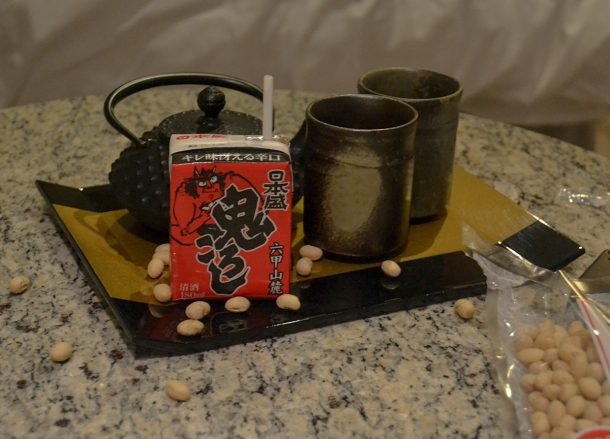
During our stay, we also celebrate the Setsubun festival, which marks the first day of spring in Japan. We take part in the traditional tossing of beans at “oni” demons from the comfort of our guestroom. But given short notice—and with no demons on hand—we make do by throwing soybeans at cartons of demon sake (Nihon Sakari Oni Koroshi) to symbolically cleanse away the evil of the past year.


Back Down to Earth
The one problem with our oasis in the sky is that it’s just really hard to leave. With our limited time in the hotel, I honestly just wanted to soak in the bath for an hour or two. Fortunately, we’re almost directly connected to the subway and JR lines at Tennoji Station, so travel to and from the hotel is ridiculously easy.
This was also our second visit to Osaka. After our last short encounter, we promised to return and explore more—and inevitably, we decided to both start and end our travels in Osaka this time around.
Just a couple of stops in either direction brings us to our main areas of interest: the Dotonbori Canal (Namba) and Shinsekai, home to the iconic Tsutenkaku Tower. Both areas are visually fascinating, with neon-lit walls and endless billboards of food—glorious food. This is exactly why we were so eager to return. Osaka is often known for its obsession with eating, even earning a bit of a reputation for gluttony.
There’s a saying in Japan: “Osaka wa kuidaore”—meaning “Osaka people eat ’til they drop.” And that pretty much sums up our plans for our time here.
There will be full food posts to come, but one snack not to be missed in Osaka is takoyaki—the hugely popular street food of octopus-filled dough balls. They originated here and are filled with chopped tentacles and other savory mix-ins.
Thanks to the convenience of our location and the punctuality of the trains, we’re able to explore easily and return to our sky-high retreat in no time.


This is a beautiful description of the delights of Osaka and of course that surreal hotel you stayed in. Keep up the good work.