
Contents
Updated November 2026. This is my firsthand 2025 journey, with current railway, visa and border guidance added for readers planning the trip today.
To highlight how simple the Bangkok to China rail journey can be — I travelled with little more than passport, wallet, phone, and clothes. No laptops, printed paper, or pre-arranged visas. I completed the journey in 48 hours, including a relaxed overnight stay in Vientiane.
For a closer look at the Vientiane–Kunming stretch, including first-class seats, tickets, Boten–Mohan immigration and my video diary, see my Laos to China by Train guide. This article covers the longer route from Bangkok.
If you continue your China trip towards Hong Kong, my Hong Kong stopover guide by metro (MTR) covers the main attractions, transport connections and Tourist Octopus Card.
I travelled solely with Thai baht and didn’t once take out or receive Lao Kip or Chinese Yuan. Instead, I booked the journey in advance and relied on my phone and phone apps to get me there (I share these apps below).
I should also point out that I am familiar with much of the journey from Bangkok to China by train— I live in Bangkok, have taken the overnight train to Laos, I’ve visited Vientiane a bunch of times, I’ve been to Kunming, and I’ve travelled on various high-speed trains in China before.
So this was more me testing the route, the immigration process at the Lao-China border, and I’ve just got too much time on my hands.
I was also in Kunming earlier this year checking out some of the main train lines and tourist attractions of Yunnan province. Shangri-La covered in snow was unexpected and a complete contrast to the relentless heats we’re used to in Bangkok. Yet it’s only a couple days to reach from Thailand by train.
I also set up an Instagram (10 years too late) to share my journey from Bangkok to Kunming by train and all my other adventures in China in real time. You can find it here. For all the awesome reasons to visit China here. This article contains affiliate links.



Bangkok to China by Train (Best Route)
There may be alternative routes, but here I share what I consider to be the route through Laos to China by rail. While there are potential stops along the way, this guide follows the most direct route from Bangkok to Kunming via Vientiane.
For readers extending a longer trip through the region, my Singapore to China by Train guide covers the Malaysian and Thai railway legs that connect with this route. The journey here starts with an overnight train from Bangkok (Krung Thep Aphiwat) to Vientiane Railway Station (Khamsavath Station) via the border crossing at Nong Khai.
After an overnight stay in Vientiane, I take the early high-speed train from Vientiane to Kunming, passing through immigration at the Chinese border.
Many travellers choose stopovers at Vang Vieng or Luang Prabang, which make excellent additions to a Laos–China rail journey. Both are served by trains along the line, but check the current service and station connections before planning your overnight stay. On my original 2025 trip I was happy to continue through to Kunming.
I share the full video guide below or read on for more detailed and up-to-date info:
How long from Bangkok to China (Kunming) by train?
I left Bangkok at 8:00 PM and arrived two days later in Kunming at 8:00 PM with an overnight stop in Vientiane. That’s roughly 48 hours total although these is a 1-hour time difference between Thailand and China. Otherwise the basic travel time from Bangkok to China by train is:
- Bangkok to Vientiane: ~12 hours (including border procedures)
- Overnight Stay: 1 night in Vientiane
- Vientiane to Kunming: ~9 hours 30 mins via high-speed train
- Time Zone Difference: +1 hour in China compared to Thailand and Laos
Total duration is approximately 48 hours, including the overnight stay. For a more relaxed and enjoyable journey, however, I would consider optional stopovers at Vang Vieng (pictured below) and Luang Prabang.


Visa Requirements for Laos and China
All passports are different, so it’s best to check your specific visa requirements in advance.
I travelled on my Irish passport in 2025, when China allowed Irish visitors up to 30 days visa-free but British passport holders faced different rules. Updated November 2026: Ordinary Irish and British passports are now both eligible for up to 30 days visa-free in China under policies announced through 31 December 2026. Check the Irish and British official notices for later journeys.
Both my British and Irish passports required arrangements to enter Laos. Eligible visitors can apply for the official Lao eVisa, accepted at Khamsavath railway station. Apply in advance and note that the official eVisa FAQ requires a printed approval letter. Check your own nationality and entry point before travel.
I share the immigration procedures at the respective borders in the journey details below..
Essential Travel Apps
I relied heavily on apps and had booked the journey in advance, so I didn’t have to withdraw local currency during my 2025 trip. That’s my personal experience rather than a promise that every visitor can travel cash-free. Bring a backup payment method and some cash in case a card, connection or QR payment fails.
- Trip.com: Like the Agoda for China for hotel bookings but also for booking trains and travel in China and a prepaid eSIM for arrival in China (this makes a big difference). You can also use the website version if preferred.
- LCR Ticket: The official booking app for the Laos-China Railway. Note, international tickets have an official 15-day advance booking window, and email registration is now available on supported versions of the app; always check the latest requirements. However some booking agents like 12Go.asia may offer advance bookings.
- Loca: The Uber of Laos. Ideal for getting around Vientiane, especially if you’re new to the city. I personally didn’t use it and arranged a taxi through the hotel to the Vientiane Railway Station. Public transport is also an option.
- Alipay: Digital payments have mostly replaced cash in China and Alipay is one of the most useful methods. It also connects with other Apps, including Trip.com and DiDi rideshare although a little backup cash or another payment method is still sensible.
- WeChat: The Chinese version of WhatsApp. This comes in handy for contacting hotels and travel companies with easy English-Chinese translations. It can also be used for payments similar to Alipay.
- Google Translate (check connectivity): if approaching anyone with queries or questions I’d always translate in advance to make the whole lost in translation thing much easier. There’s also a translation app on WeChat and Alipay.
- Amaps: The Chinese alternative to Google Maps. Google Maps may be unreliable or incomplete in mainland China, whereas Amaps is so accurate locally it literally counts down the traffic lights. It also connects through Trip.com for directions to hotels etc.
- DiDi Ride-hailing: The Chinese alternative to Uber. We were unable to use DiDi on our first visit (it required a local phone number when setting up in China). We otherwise set it up in Thailand before our 2nd visit and it made getting around a breeze.
Setting Up the Apps
While it’s possible to travel in China without apps, they make travel significantly easier. However, it’s necessary to set some up in advance, as you’ll need to link bank cards, verify phone numbers, and receive SMS messages for full functionality.
An example, from our first visit, we did not have DiDi installed and were unable to create an account without a Chinese phone number when in China. It is possible however to download the app outside China and set it up with a foreign number (at the time). On this instance we relied on metered taxis, and missed out on a couple opportunities without having the DiDi rideshare app.
Choosing a Travel eSIM
See all those apps above? They’re all a bit useless without access when travelling. More importantly when arriving in China. Be sure to bring a power bank or two as well as there may not be charging options along the way. There are power sockets on overnight Thai trains, and first class trains in China have USB charging ports but not always 2nd class. I’m fairly sure there was no WiFi internet option on either train.
I personally have a SIM card for Thailand, so that was not an issue, and with just 24 hours in Laos I decided to forgo internet for a while. I managed to get by, but f needed you can get eSims for either on Klook or Trip.com.
A China eSIM made this journey easier for me; I have used Trip.com travel eSIMs for data, translation and payments on arrival. Some overseas roaming eSIMs may allow access to apps normally restricted on Chinese local networks, but not every eSIM includes a VPN or bypass. Check coverage, restrictions, activation instructions and the current package details before booking.
Bangkok to Vientiane by Train
For the direct rail route, Train 133 travels overnight from Bangkok’s Krung Thep Aphiwat Central Terminal via Nong Khai to Vientiane Khamsavath. Allow roughly 12 hours including border formalities. Alternatively take another sleeper from Bangkok to Nong Khai and connect onward. Khamsavath is not the Laos–China Railway station at Don Noun; arrange a taxi or minivan across Vientiane. Book Thai trains through SRT D-Ticket.
Train from Bangkok to Vientiane
I’d book the Bangkok–Vientiane sleeper as soon as my dates were firm, especially if I wanted a berth. International Laos–China Railway ticket sales can open around 15 days before departure, and booking windows may differ from domestic Lao trains. On my original 2025 trip I booked the Laos–China leg first and then found the direct Bangkok–Vientiane service fully booked, which is why I took the Nong Khai alternative.
On my original journey in 2025, the direct Vientiane train had sold out, so I used an earlier Bangkok–Nong Khai sleeper and connected over the border. That gave me more time to clear the exit formalities. The options, train classes and connections change, so check the official SRT D-Ticket timetable and booking service rather than treating the fare and timing of my journey as current advice.


Crossing the Border at Nong Khai Thailand
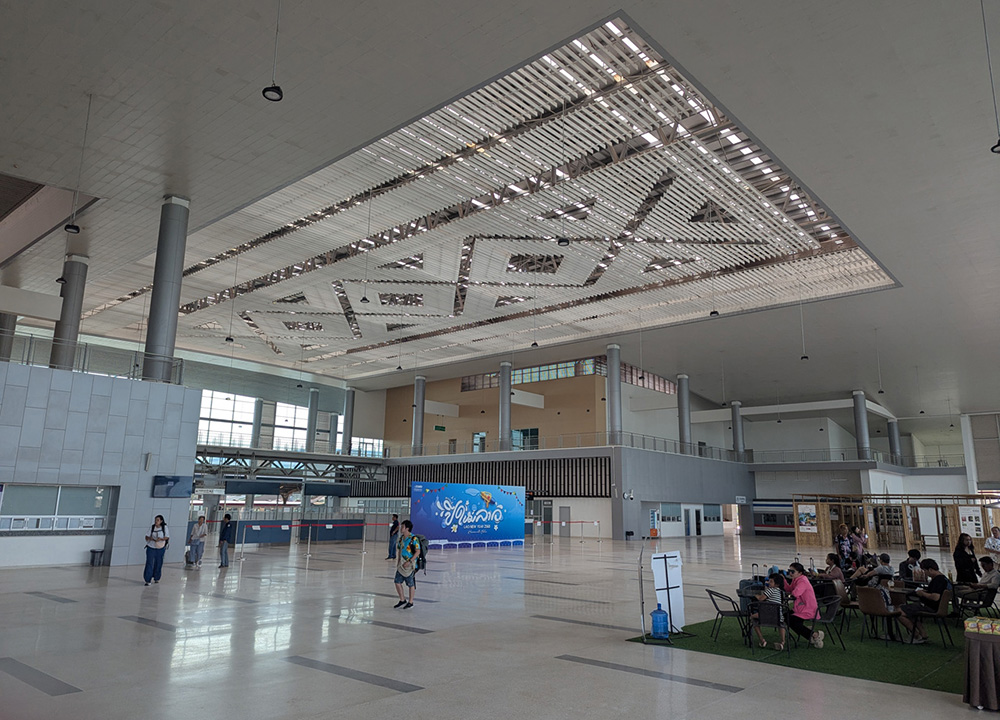
After Thai exit formalities at Nong Khai, the train crosses the Friendship Bridge to Vientiane Khamsavath, where travellers enter Laos. The border procedures require your documents and luggage. The Don Noun station for the China-bound high-speed railway is elsewhere in Vientiane, so allow an overnight stay or generous time for the onward transfer.
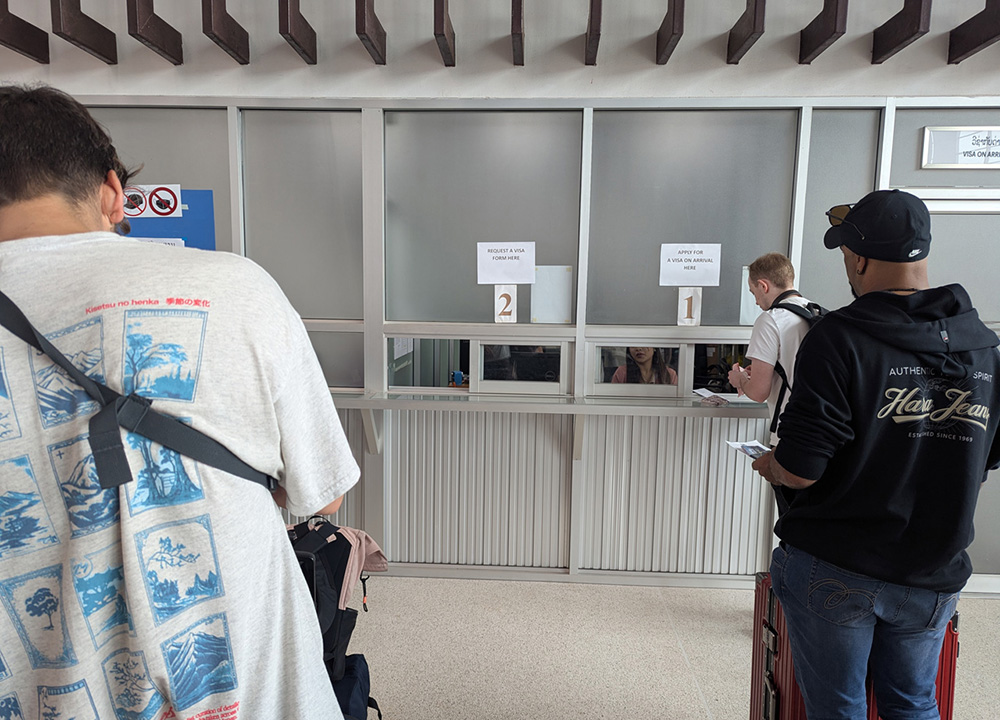
VISA for Laos
For my journey in 2025, I left the Laos visa too late to apply online and chose visa on arrival instead. Today, eligible travellers can apply for the official Lao eVisa, which lists Khamsavath railway station as an approved entry point. Apply several days in advance and print the approval letter as required.
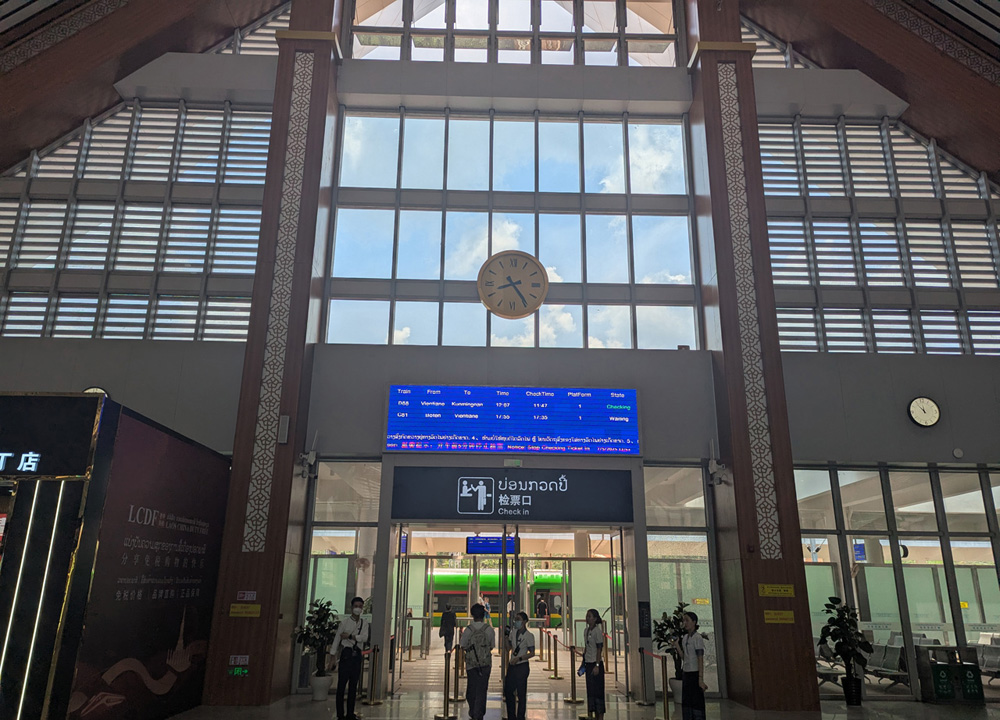
In 2025 my visa-on-arrival queue was unusually short, although you should not assume that will always be the case. New for 2026: Laos has introduced the Lao Digital Immigration Form (LDIF) for travel arrivals and departures. Check its current coverage and whether you must submit it within three days of each crossing. The digital form is separate from any visa. My paper arrival cards were part of the original 2025 trip.

Onward Travel into Vientiane, Laos
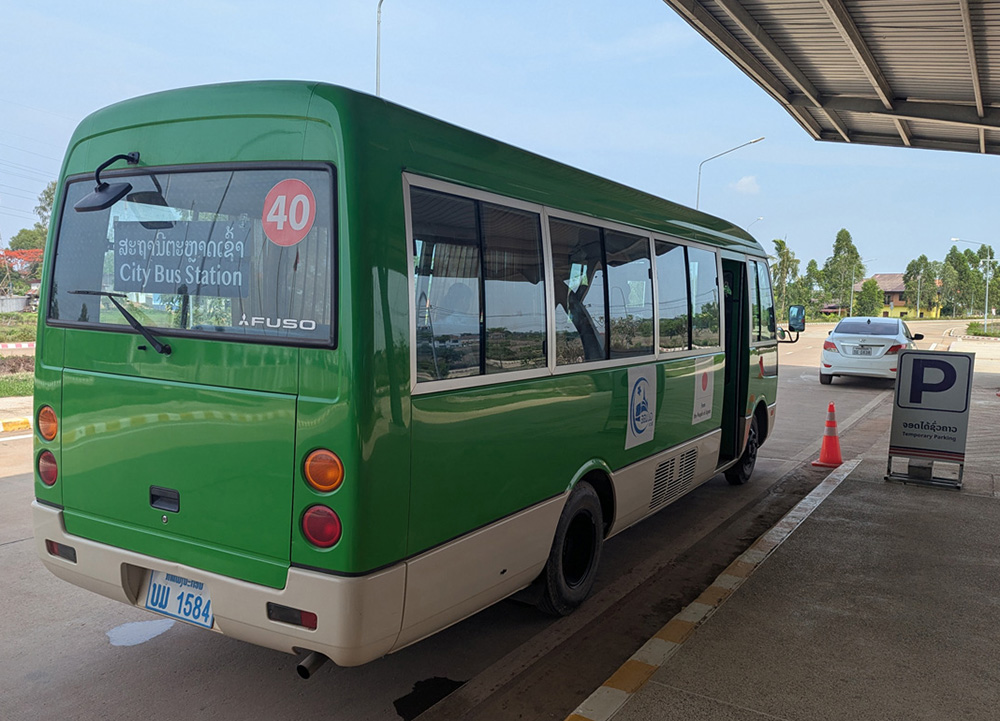
It’s a good 20–30 minute drive from Vientiane Railway Station (Khamsavath Station) to the centre of Laos. It is easy to find taxis for onward travel but they are expensive and so I take the minibus for around 35 Baht. Fortunately, almost everywhere in Vientiane accepts Thai baht.
This is where things can be a little tricky without a phone with data connection and I regret not saving a map to the hotel (I may rely too much on apps). There are taxis and tuktuks but I don’t trust anything without meters. Instead I asked directions to the riverside and by some fluke I found my hotel which I knew was at least near Nam Phlu. Vientiane is a fairly small and simple city to navigate on foot (our guide here).
Vientiane to Kunming by Train
The Laos–China Railway runs from Vientiane’s Don Noun station through Boten–Mohan to Kunming South (Kunmingnan). On my 2025 journey it took approximately nine and a half hours, including immigration, with first- and second-class seats rather than sleepers. Check current international departures in the LCR Ticket app or with China Railway 12306. I’ve also covered booking and border formalities in my Laos to China by Train guide.
Getting to Vientiane Railway Station?
For my 2025 departure, the Vientiane–Kunming train left in the morning and I didn’t want to risk missing it. I skipped the early bus from the Morning Market and arranged a taxi through my hotel instead. The hotel charged 300,000 kip (about 450 baht at the time), compared with 260,000 kip quoted by the Loca app. Those are historical prices from my journey, not current taxi fares.
I may have been overly cautious here for the Vientiane to Kunming train, partly because the roads were torn up at the time, and the hotel said delays were expected. They recommended leaving at 6:30AM for the 8AM departure to give myself time to get my paper tickets. (Note, normally a passport is only needed for boarding trains in China).
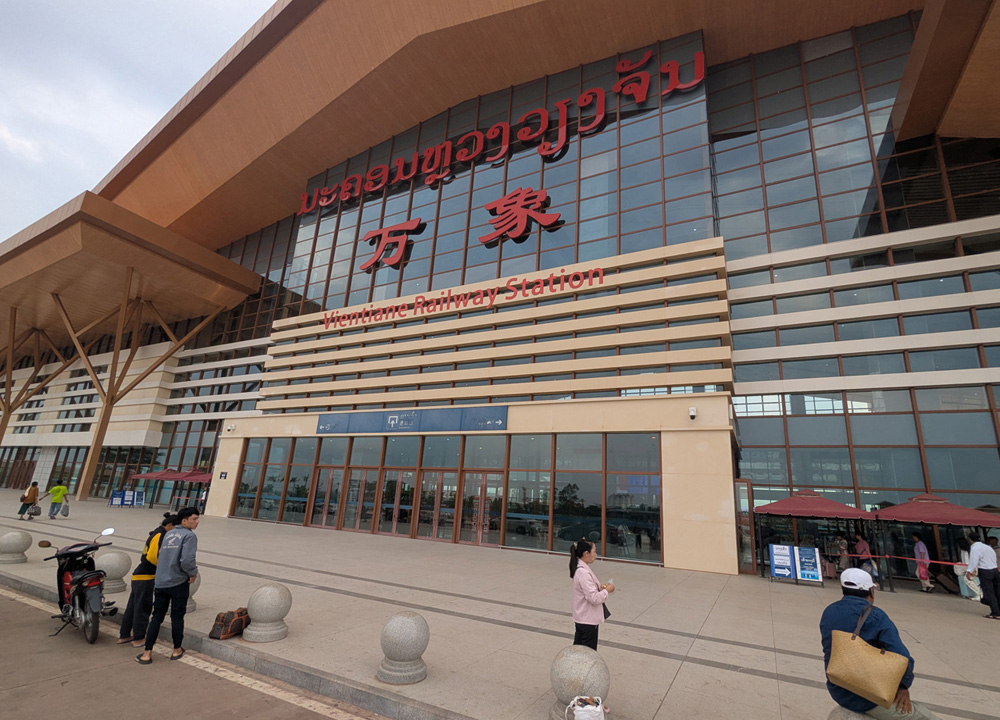
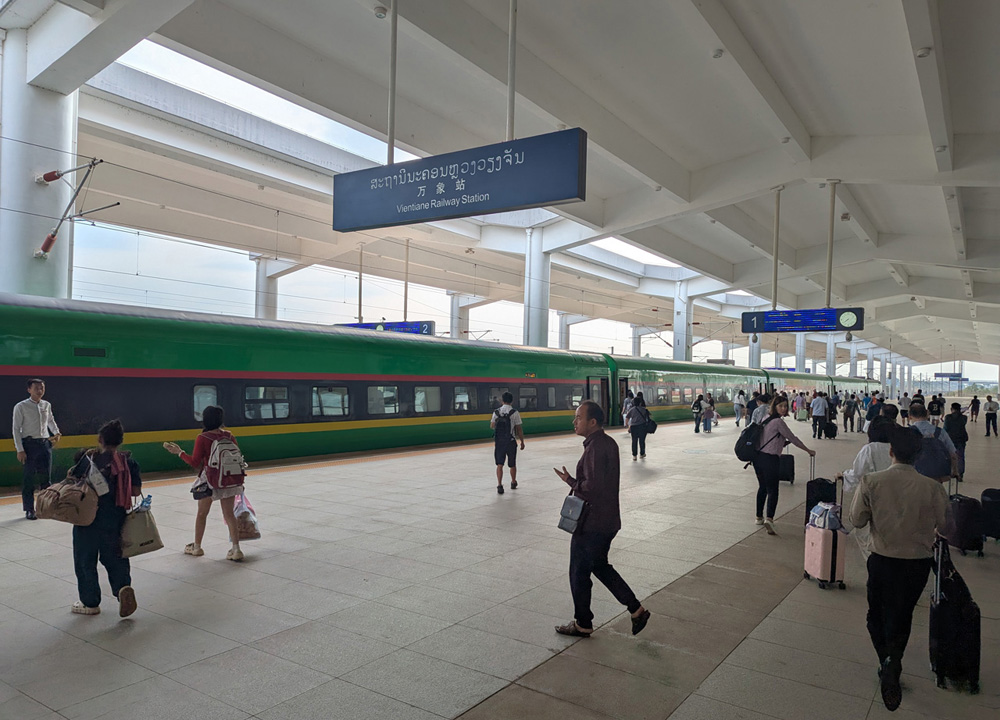
On the morning of my 2025 journey, the hotel taxi got me to Don Noun in about 25 minutes. I collected my paper ticket and cleared security well before boarding. With passport checks and security before international train departures, I would still leave extra time rather than rely on those exact timings today.
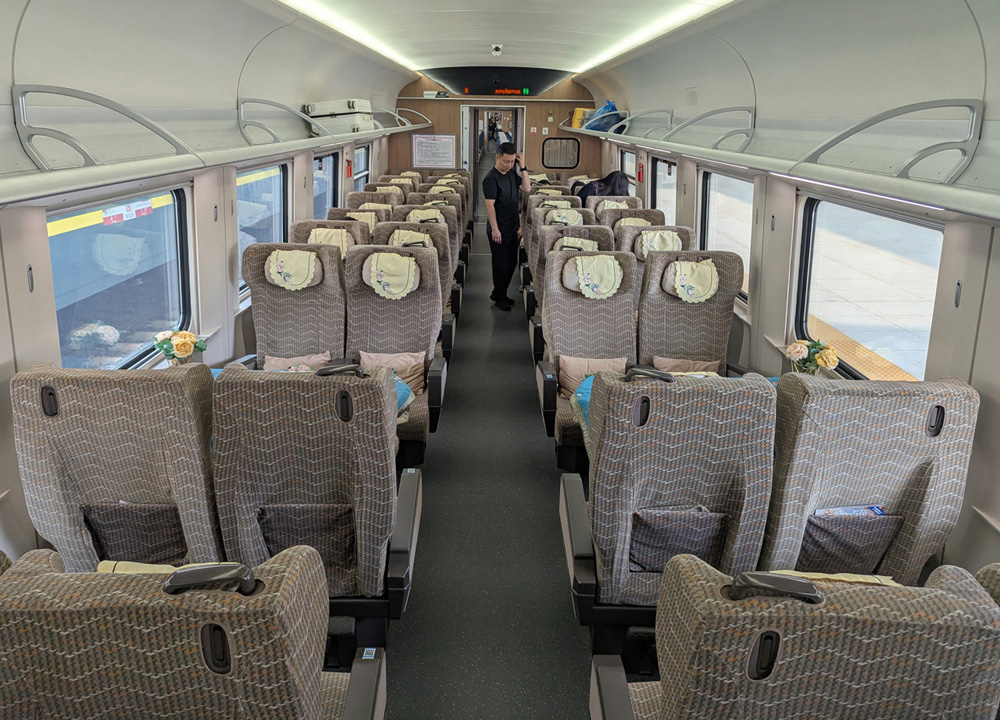
With the long journey ahead, I opted for 1st class, which isn’t a huge mark-up in price or comfort when it comes to Chinese trains. I found myself on the train on the left side, which has the best scenery when passing Vang Vieng, Luang Prabang, etc. but I was riding backwards. Maybe double check this on booking (something I obviously missed).
The train was fairly empty until Luang Prabang, then it quickly became full as Luang Prabang seems to be a popular destination for Chinese holidaymakers.

Boten Border Crossing (Laos/China)
Our baggage was checked when boarding the train, as it is at every stop, so I was hoping to leave baggage on the train while we hopped off at immigration (similar to the Thailand–Laos border).
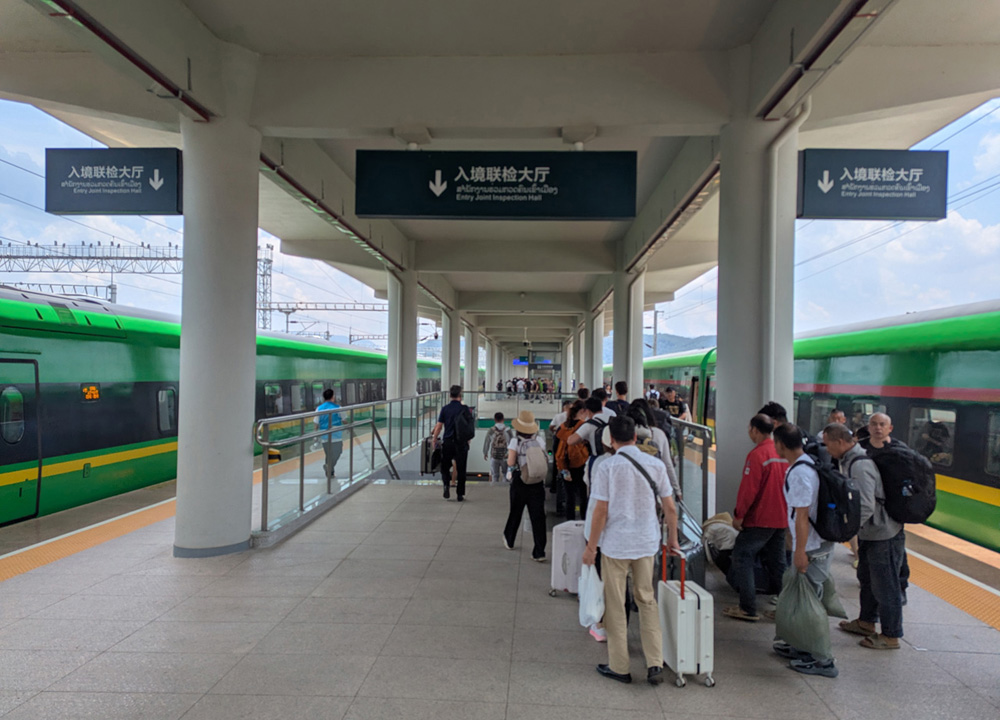
Nope. You must disembark with luggage at the Lao side of the Boten border and go through security before the passport check. You then bounce back on the train, and it’s a short stretch to reach the Chinese checkpoint at Mohan.
Chinese Immigration and Visa Requirements
I used my Irish passport for 30-day visa-free entry on this 2025 train journey. Since 17 February 2026, ordinary British passport holders also qualify for up to 30 days visa-free for permitted trips; the published Irish and UK policies currently extend to 31 December 2026. See the official Irish and British notices. Other nationalities may still need an advance visa.
I also tried a British passport transit waiver on a separate 2025 visit to Shanghai before continuing to Hong Kong. That was under the older transit rules, not the 2026 30-day visa exemption. See my Shanghai Bund guide for more from that trip.
Chinese Immigration at Mohan
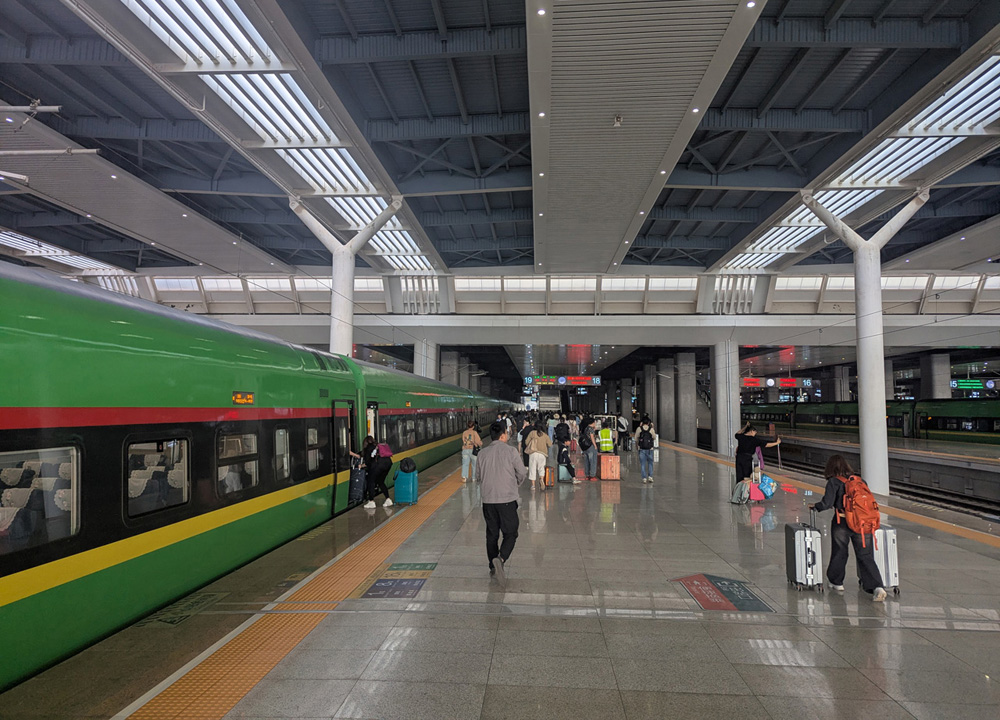
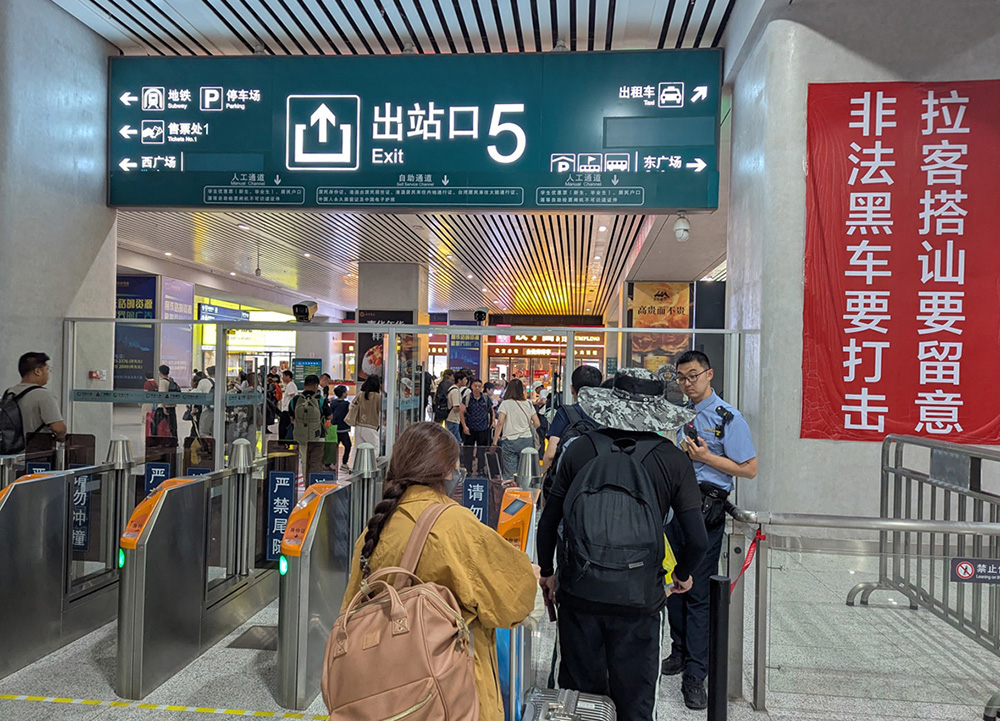
Laos and China are connected by a 10 km tunnel (Friendship Tunnel) and after about 15 minutes we reach the China side where we disembark with our bags again to be checked at customs again.
On my 2025 journey we were handed paper Chinese arrival cards onboard the train. Since 20 November 2025, eligible foreigners can also complete the free official China arrival card online before entering. Paper cards remain available at the border. Avoid imitation paid websites.
It takes roughly 20 minutes to clear immigration and we’re ready to board again.
Mohan to Kunming by Train
Hop back on the train and it’s roughly 4 hours 30 mins to Kunming. The rest is fairly simple now with the prepaid eSim. At least there’s no more borders to cross and it’s a straight line to China. Bangkok to China by train complete.
There are fewer passengers on the approach to Kunming, so I switched seats without an issue, which I kind of needed as a stereotype which we thankfully didn’t meet in the last two visits to China ended up sitting beside me
The guy next to me had been sneaking off for smokes at every stop, he slurped noodles like a cartoon character, and kept sucking his teeth afterwards. He hocked up so many loogies he was asking for extra sick bags.
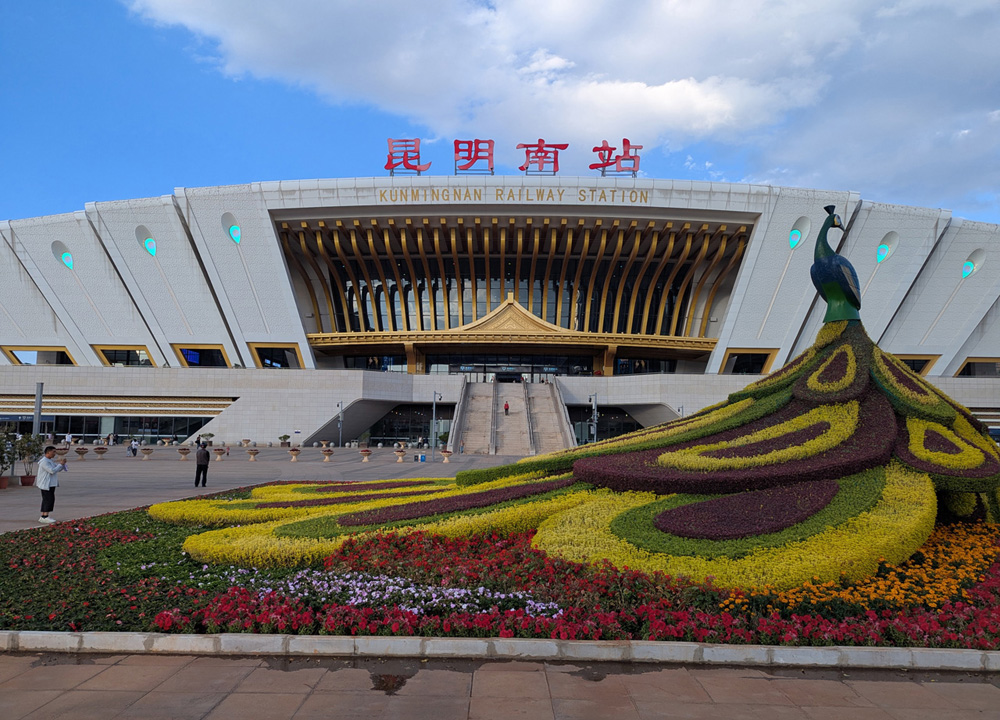
Arrival at Kunming South Station (Kunmingnan)
Tickets show as Kunmingnan which is just the name for the Kunming South Station (Nan means south). This is also where the apps I recommend come in handy starting with Alipay for QR payments that are now as widely used as cash. WeChat can also be used for payments but I used it more for contacting hotels. It’s always a good backup otherwise.
These two payment systems also connect with DiDi car hailing for onward travel. Car hailing is cheap in China but the metro is cheaper and using the Metro Man app it is easy to find the nearest station to hotels and attractions, and then follow Amaps, like with Google Maps, for the rest of the way.
Learn these apps and travel in China is a breeze.

Kunming, Yunnan, and Beyond
From Kunming there are onward high-speed rail services to Shanghai, Hong Kong, Beijing and Xi’an, among many other destinations. Train times vary enormously by departure and service, so use China Railway 12306 for the current domestic timetable. My own visit continued through more of southwest China.
I also looked towards Tibet and the Himalayas. Lhasa is connected to China’s conventional railway network, but not by a completed high-speed route from Chengdu. New western railway projects are underway, so I would check current progress before planning a future rail journey there.
Otherwise, my personal interest is in exploring the surrounding Yunnan region for now and the neighbouring provinces with trains out of Kunming. Plus, I’ve already been to the big tourist cities listed above.
For the longer distances, I would recommend 1st class seats, as prices are not hugely different but the added comfort is worthwhile. For current train departure times and fares, use the official China Railway 12306 or compare domestic trains through Trip.com China Train Tickets. Compare final booking totals, as third-party service fees may apply.
Here we also share our original 7 Day itinerary in Yunnan province. Another couple of nearby attractions that I didn’t include are Guiyang (2h26m) and Dali (1h52m). Note, I’m using the current shortest travel duration from Kunming.



Kunming (Capital of Yunnan)
I always say that Kunming is the gateway to Yunnan and is a great base for travel in the region. But it is also an amazing city in itself and I regret seeing it mostly in passing.
This was no different on this train journey from Bangkok to China when I stayed next to Kunming South Railway Station (Kunmingnan) for the night before an early train to Chengdu the next morning. At the same time, we have stayed in different and contrasting areas of Kunming during our short stays.
The first visit we stayed in the Green Lake area with hotel views over the park. A simple relaxed stay with nice walks in the nearby temples and park.
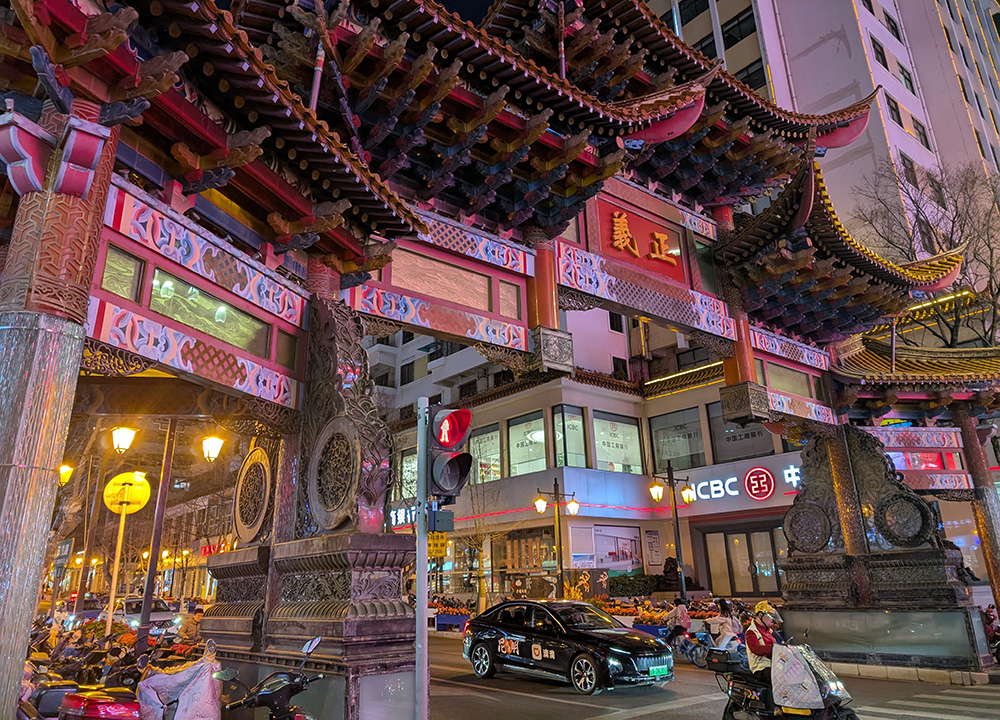
Then it was Nanjing Pedestrian Street (below), a modern vibrant commercial district just a short walk from the lively Kunming Old Street, a hub for great food and restaurants.
I’m sure there’s a lot more to it but otherwise, it has been a great base for travel and I always look forward to getting back.


Guilin and Yangshuo
Of this list, we haven’t been to Guilin or Yangshuo, so here are some free stock images and an AI-generated quick guide in the tone of a stoned backpacker. Enjoy:
Took the high-speed train into Guilin, a laid-back city surrounded by surreal karst peaks. Grab Guilin rice noodles, stroll the riverside, and catch some tai chi in the parks.
But the real magic’s in Yangshuo, about 1.5–2 hours away by bus or van. The journey winds through jaw-dropping limestone mountains and into pure backpacker bliss. Yangshuo is made for wandering—bike through rice fields, float down the Yulong River on a bamboo raft, or hike Moon Hill for killer views.



Lijiang
Lijiang Old Town (UNESCO) is a labyrinth of cobbled lanes, traditional rooftops, and mountain views in the distance. It is a tad touristy these these days, the old buildings reimagined with modern shops selling snacks, and souvenirs, as well as costume shops for photo ops in traditional garb). Plenty of local food of course including the region’s famous yak meat hot pot.
Lijiang Old Town is otherwise the perfect base to explore the surrounding scenery where the main highlight would be the cable cars to Yulong Snow Mountain (Yunshanping Cableway). This takes you right up to the snowy peaks where they have a daily impressive outdoor performance (the Impressions of Lijiang) set against the glacier backdrop.



Shangri-La
This route can be covered by direct train from Kunming or hopping through Lijiang as a waypoint (1–2 hours) as we did. We also arrived to snow as this Tibetan region of Yunnan is high in the mountains at 3,000m. The best base in Shangri-La would be Dukezong Ancient Town, a charming, rustic maze of Tibetan alleyways, temples, and old homes beneath Guishan Temple and a massive prayer wheel.
A tour of Balagezong Scenic Area is recommended (we missed out due to weather) but there is otherwise lots to explore nearby, including the famous Ganden Sumtseling Monastery—Shangri-La’s main attraction. Another more rural area is the serene Napa Lake Grasslands, with peaceful views, and herds of local cattle and wildlife. We stayed in each of the 3 different areas here (Balagezong, Ganden Sumtseling Monastery, and Napa Lake) and it’s easy to get around with Didi rideshare.


Chongqing
Chongqing is enormous, and the municipality is much bigger than the dense city centre most visitors explore. It is famous for Sichuan-style hot pot, spectacular riverside skyscrapers and its links to the Three Gorges region. Chongqing became a municipality directly administered by China’s central government in 1997; comparing its entire administrative population with ordinary city populations can be misleading.
Chongqing has an almost constant haze (aka the “Foggy City”) due to humidity from the Yangtze River and surrounding mountains. It is also famous for cyberpunk vibes, with corporate skyscrapers towering over labyrinths of high-rise tenements and ancient temples. There’s skywalks connecting apartment blocks, monorails going through residential buildings, and streets constantly buzzing with electric vehicles. Check out Hongya Cave, the Yangtze River Cableway, and of course its food.


Chengdu
Panda, panda, panda. Chengdu, the capital of Sichuan Province, is one of China’s great megacities. Unlike the hazy atmosphere in Chongqing, Chengdu has a greener, more relaxed feel, with cycle lanes and greenways throughout parts of the urban area. Its most famous residents, of course, are the giant pandas.
I don’t think you can stand anywhere in Chengdu without seeing a panda (we tried and failed). And if you do, a panda bus will likely drive past. They are everywhere. To see the real thing though, you can go to the Chengdu Panda Research Base or take a train to Dujiangyan for the Dujiangyan Panda Base (we did both).
Otherwise, Chengdu is all about mala, the spicy blend of chillies and Sichuan peppercorns that made Sichuan food famous and Chengdu the first UNESCO City of Gastronomy in Asia (2nd in the world).


Bangkok to China by Train: Frequently Asked Questions
Can you travel from Bangkok to China entirely by train?
Yes. An overnight train connects Bangkok to Vientiane Khamsavath in Laos, and the Laos–China Railway runs from a separate Vientiane station at Don Noun to Kunming South. You need to transfer across Vientiane; there is no single through train or ticket.
Which Bangkok train goes to Vientiane?
The direct overnight service is Train 133 from Krung Thep Aphiwat Central Terminal to Vientiane Khamsavath, via Nong Khai. Check the latest departures and tickets using SRT D-Ticket.
Can I catch the Laos–China train at Khamsavath?
No. Thai services use Khamsavath station, whereas trains to Kunming depart from Vientiane Don Noun. Allow a local transfer and ideally an overnight stay in the city.
Do British and Irish citizens need a China visa in 2026?
As of November 2026, eligible ordinary British and Irish passports both qualify for up to 30 days visa-free for tourism and other permitted visits, under policies published through 31 December 2026. Check British or Irish official information before future travel.
Do you need a visa and arrival form for Laos?
Most British and Irish visitors need a Lao visa. Khamsavath accepts the official Lao eVisa, which requires a printed approval letter, and eligible travellers may have a visa-on-arrival option. Check the Lao Digital Immigration Form (LDIF) requirements separately.
How long does the Bangkok to Kunming journey take?
My 2025 trip took about 48 hours in total, including a relaxed night in Vientiane. Actual journey time depends on the Bangkok overnight train, local station transfer, international train schedule and immigration. Book the two rail legs separately and leave a sensible buffer.
Do you leave the train at the Boten–Mohan border?
Yes. Passengers normally disembark with their luggage at both the Lao exit checkpoint in Boten and the Chinese entry checkpoint in Mohan. See my detailed Laos to China Railway guide for the firsthand border experience.
Where can I travel after reaching Kunming?
China’s rail network connects Kunming to destinations such as Lijiang, Shangri-La, Chengdu, Shanghai and Hong Kong. Check China Railway 12306 for current services, and see my Yunnan itinerary for the surrounding region.
It’s an exciting post to read, and I wish to embark on the same route from Bangkok to China maybe next year.
But I found it rather distasteful and that you so harshly criticize the mate sitting next to you on the train. Calling him “stereotype” of Chinese people is also quite uncivil of you.
Fair enough. But it is the stereotype of Chinese people, regardless. Spitting, smoking, being uncivil. If anything, I am trying to debunk this stereotype in modern Chinese society. Trying to highlight that, while it does exist, it is rare to find now. I also prefer to be honest in my writing and highlight my own personal experience. If that’s being uncivil, so be it. I am not going to lie.
I also highlight how quickly China has evolved in recent years and promote it as the next big destination in Asia:
https://live-less-ordinary.com/why-china-is-the-next-big-travel-destination/
Dear Allan & Fanfan,
Thanks for putting this together. Super useful! I’ll be making this trip soon and I would like to know what kind of visa you got on the Laos border, transit or tourist?
Thanks,
Robin
Just tourist visa here. Not sure about transit. Been 4 times to Laos on short stays and just go with the tourist visa on arrival. Passport control isn’t actually at the Laos border on this instance but is issued at the arrival train station further along at Vientiane.
Hey hey,
I tried getting a transit visa but it wasn’t available at Vientiane train station.
Tourist visa on arrival only
I am not clear about the borader crossing at Nong Khai in Thailand and Khamsavath in Loas. Can you explain a bit details.
Do we need to disembark the train and board the same train again to Khamsavath? Where is the imigration check point for Loas? At Nong Khai or Khamsavath?
Yes disembark at Nong Khai for immigration leaving Thailand. Then the immigration for Laos isn’t until you arrive at the station in Vientiane. A bit weird as you could jump off the train in between and be stuck in Laos with no visa. But the train is moving fast so an unlikely scenario.