
Contents
You eat roughly the same dinner for twelve nights running. That’s the first thing worth knowing.
Not identical. But close enough. Every teahouse from Lukla up to Gorak Shep runs a menu that looks photocopied from the one before it, because more or less it was. Same dishes, same running order, same laminated pages curling at the corners.
Most food guides to this Everest base camp trek stop right there. They list dal bhat, momos and pizza, mention that the pizza is better than it has any right to be, and call it a day.
The interesting part is why the menu looks like that. Once you understand how a single tomato reaches 4,410 metres, everything else falls into place. The prices. The shrinking choice. The reason your guide will quietly steer you off the yak steak. Get that, and you’ll eat considerably better for the whole walk!
Why every menu on the trail is the same
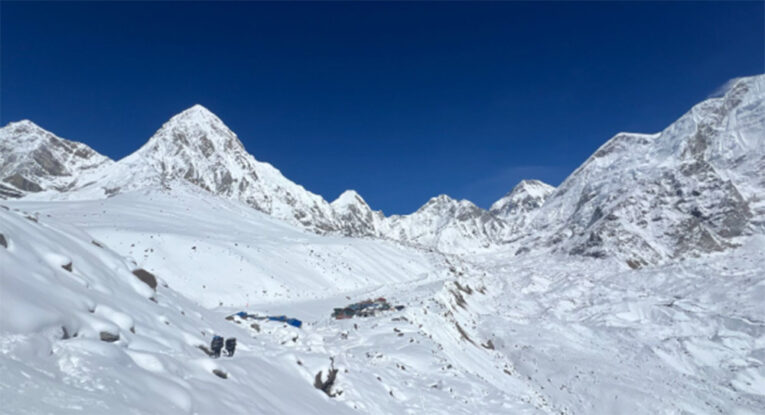
There are no roads in the Khumbu. Not one.
Everything you eat above Lukla arrived on somebody’s back, or on a zopkyo, which is a yak-cattle cross with better manners at low altitude. Prices increase with altitude, as everything above Lukla arrives on the back of a porter or yak. Beer and juice get flown to Lukla from Kathmandu first, then walked up from there.
So the menu isn’t a menu in the way you’re used to. It’s a list of what survives a three- to five-day walk without refrigeration.
That’s why you see so much rice, lentil, flour, potato, noodle and tinned everything. Dry goods travel. Fresh goods mostly don’t, though in autumn a decent amount of produce does make it up as far as Namche.
It also explains the sameness. Teahouses along the route buy from the same suppliers, carry stock the same way, and cook on the same one or two burners. There’s a regional pricing agreement in most villages too, so undercutting the lodge next door isn’t really a thing.
Once you see the trail as a supply chain rather than a restaurant strip, the food stops being disappointing and starts being quite impressive.
The price ladder: what food costs as you climb
Your dinner gets dearer roughly every 500 metres. This catches people out, because they budget from what they paid in Kathmandu.
Here’s the shape of it. Treat these as ballpark bands rather than gospel, since lodge prices shift every season.
| Where you are | Altitude | A main meal | Boiled or filtered water (1L) |
| Lukla | 2,860 m | Lowest on the trail | Cheapest refill point |
| Namche Bazaar | 3,440 m | Modest step up, best choice on the route | Still reasonable |
| Dingboche / Pheriche | 4,300 m | Noticeably dearer | Roughly double Lukla |
| Lobuche | 4,940 m | Dearer again | Climbing steadily |
| Gorak Shep | 5,164 m | Top of the ladder | Most expensive water on the trek |
Expect to pay somewhere around $10 to $15 for each meal higher up, and remember that everything gets more expensive the closer you get to Base Camp, so buy batteries, toilet paper and the like in Kathmandu, Lukla or Namche. The same logic applies to chocolate and energy bars, which get punishing near the top.
Lodges and restaurants in the Khumbu only take Nepalese rupees, so carry small notes. There are ATMs in Kathmandu, Lukla and Namche Bazaar, but they shouldn’t be treated as reliable.
One quiet point that matters more than it sounds: lodges make their money on food, not rooms. Rooms are cheap precisely because you’re expected to eat where you sleep. Eat elsewhere, and you’ll often find the room rate jumps.
Dal bhat, and why the maths works
Dal bhat is rice, lentil soup and a vegetable curry, usually with a pickle on the side.
You’ll be offered it twice a day for a fortnight. Plenty of trekkers get bored of it by Dingboche and switch to pasta, then regret it.
Two reasons it wins.
First, the refill. Most teahouses give you a free second serving, and often a third. Nothing else on the menu does that. When you’re burning through the day’s calories on a six-hour climb, bottomless rice and lentils is the single best value on the trail.
Second, turnover. Dal bhat is what the guides, porters, and the family running the lodge eat. It’s cooked fresh in volume, every day, twice a day. The pizza is not. That pizza might be the first one the kitchen has made since Tuesday.
Fresh and busy beats fancy and idle, every time, at altitude.
The dishes, honestly rated
Dal bhat — Plain on day one. Essential by day six. Ask for extra pickle and dried chilli, and it livens right up.
Thukpa — Tibetan noodle soup, hot broth, vegetables, sometimes egg noodles. Warm, wet and salty, which is precisely the combination you want at 4,000 metres. Order it when you’re too tired to chew.
Sherpa stew (shyakpa) — A soup built from homemade noodles and vegetables, sometimes with bits of meat, offering warmth and nutrition after a long day. The best local dish on the route. Order the vegetable version.
Momos — Steamed dumplings. Excellent in Namche where they’re made in quantity. Increasingly hit and miss above it, since they’re labour-heavy and kitchens are stretched.
Tibetan bread — Thick, fried, faintly sweet, eaten with jam or egg. Deeply unhealthy and completely correct for breakfast on a climbing day.
Rildok and potato dishes — Sherpa potatoes are the one genuinely local crop up here, grown in the Khumbu itself rather than carried in. They’re small, dense and good. Anything potato-based is usually a safe order.
Garlic soup — Every menu has it. Every guide recommends it. More on this below.
Yak cheese — Hard, dry, sharp. Worth buying a wedge in Namche. Not to be confused with the rock-hard chewing sort described in the Himalayan food guide on this site, which will genuinely test your fillings.
Pizza and pasta — Better than expected in Namche. Progressively stranger above it. By Lobuche, a pizza is a tomato-adjacent experience.
Apple pie — A Khumbu institution, mostly in Namche. Order it.
The meat rule, and it is a rule
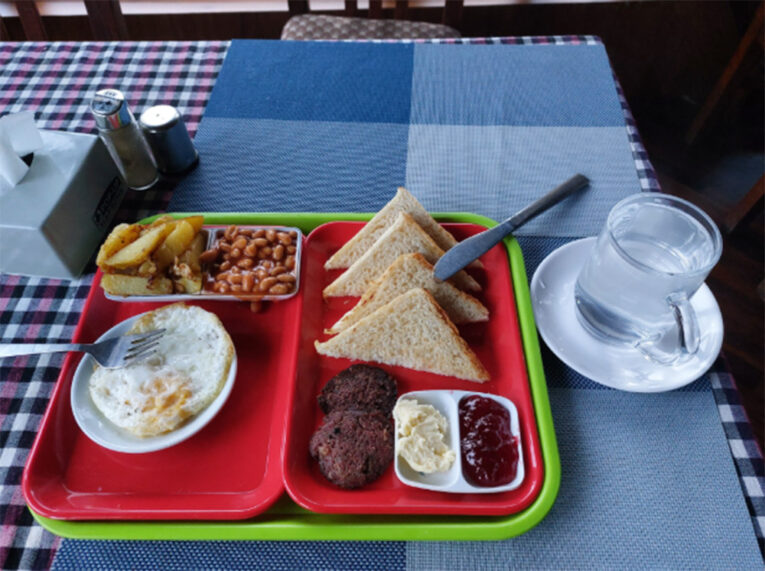
Don’t eat meat above Namche. Not “probably avoid”. Don’t.
Here’s the reasoning, and it’s cultural before it’s practical. Animal slaughter is prohibited in the Khumbu region because of local Buddhist belief, so all meat has to be brought in from lower villages or from Kathmandu.
Which means the meat on your plate has done the same walk you have. It’s carried up by porter or yak over several days, without refrigeration. Often in wicker baskets in direct sun, going through repeated thaw and refreeze cycles on the way.
Yes, yak steak is on the menu. No, the yak wasn’t killed locally.
A stomach bug at 4,900 metres isn’t just miserable. It dehydrates you fast, and dehydration makes altitude symptoms markedly worse. That’s how a bad dinner turns into an aborted trek.
The good news is that going vegetarian here costs you nothing. The menu leans plant-forward the higher you go anyway, and vegetable-led cooking is the standard rather than the compromise. Eat your buff momos in Kathmandu and your yak steak in Namche on the way back down, if at all.
Your appetite will vanish, and that’s the actual problem
Nobody warns you about this properly.
Somewhere above Dingboche, food stops being appealing. Not because it’s bad. Because your body has decided digestion is no longer a priority.
This is well documented. Altitude lowers ghrelin, the hunger hormone, and raises leptin, the fullness hormone, so your body stops asking for fuel even while you’re burning through it. Blood gets shunted away from the gut, stomach motility slows, and normal hunger signals weaken.
Meanwhile, the demand goes the other way. Above roughly 3,500 to 4,000 metres, basal metabolic rate typically rises by around 10 to 25 percent.
The research backs it up. In the Operation Everest III study, eight men were exposed to a 31-day simulated ascent with unlimited palatable food and no cold or exercise, and still lost an average of 5 kg, almost entirely through eating less. No trial. No cold. No rucksack. They simply stopped wanting to eat.
So the practical rule is this: eat on schedule, not on appetite.
- Order something at every stop, even a small thing
- Load up properly at Namche and Dingboche, where the food is best, and you still want it
- Warm liquid calories go down when solids won’t, so soup and sweet tea earn their keep
- Carbohydrates are easier to digest at altitude than fat, so lean on rice, potato and noodles
- Never skip breakfast on an ascent day
The trekkers who struggle above Lobuche are very often the ones who quietly stopped eating two days earlier.
Drinks, tea and the alcohol question
Tea is the fuel of this trail. Ginger, lemon, mint, masala, black, and the ubiquitous ginger-lemon-honey that half the trail treats as medicine.
Buy it by the flask rather than the cup. A thermos of hot water or tea is far better value than four separate mugs, and it keeps working all afternoon.
Butter tea is worth trying once. Salted, buttery, closer to a thin broth than a brew. It makes complete sense at minus ten and very little at any other time.
Alcohol is where you should hold off. Chang, the local millet or rice beer, and rakshi, the distilled version, are both part of Sherpa hospitality and both genuinely interesting. Save them for the walk back down. Alcohol dehydrates you, suppresses your breathing overnight and worsens sleep, all of which work directly against acclimatisation. Have the celebratory beer in Namche on the return leg. It’ll taste better then anyway.
Water, which costs more than you think
This one item can quietly eat a chunk of your budget.
Single-use plastic has been banned in the Khumbu since January 2020, though enforcement varies. Either way, buying bottled water daily for two weeks is expensive and leaves a mess in a region with almost no waste infrastructure.
Teahouse boiled or filtered water typically runs somewhere between 25 and 100 rupees a litre, rising with altitude, and boiling is highly effective against both bacterial and viral pathogens. Above 2,000 metres, hold a rolling boil for at least three minutes.
Bring a filter or purification tablets and a couple of one-litre bottles. It costs a few pounds for the entire trek instead of a small fortune, and there’s a genuine trick to it: fill a bottle with boiled water at dinner, put it in your sleeping bag as a hot water bottle overnight, and drink it cold in the morning. Two jobs, one purchase.
How to order in a teahouse without annoying everyone
Small thing, big difference. Most kitchens are one room with two burners and one or two people cooking.
- Order together. If your whole table orders the same dish, it arrives in twenty minutes. Six different dishes can take well over an hour.
- Order dinner when you arrive, not when you’re hungry. Most lodges take orders in the afternoon and cook at a set time.
- Order breakfast the night before. Standard practice, and it gets you out on time.
- Eat in the dining room. It’s the only heated space in the building, warmed by a stove that’s often burning yak dung. Your bedroom will be freezing.
- Simple beats ambitious. A kitchen that does dal bhat forty times a night does it well.
What to carry from Kathmandu
Buy snacks before you fly. Everything in this list costs a fraction of the trail price.
Nuts, dried fruit, chocolate, energy bars, electrolyte sachets, instant coffee if you’re fussy, and a few packets of Wai Wai noodles. Electrolytes are the underrated one, since they make plain boiled water far easier to drink in the volumes you need.
Frequently asked questions
What food is available on the Everest Base Camp trek?
Teahouse menus cover Nepali staples like dal bhat, thukpa, momos and Sherpa stew, alongside Western options such as pasta, pizza, fried rice, soups, porridge, eggs and Tibetan bread. The choice narrows as you climb, but every lodge from Lukla to Gorak Shep serves hot cooked meals three times a day.
How much does food cost on the Everest Base Camp trek?
Budget roughly $25 to $40 a day for three meals plus drinks, rising as you gain altitude. Meals near Base Camp typically run $10 to $15 each. Add extra for hot drinks, boiled water, snacks, charging and wifi, all of which are charged separately.
Can you eat meat on the Everest Base Camp trek?
You can, but you shouldn’t above Namche Bazaar. Slaughter is prohibited in the Khumbu, so all meat is carried up unrefrigerated over several days. Stomach illness at altitude is a genuine trek-ender. Vegetarian dishes are fresher, cheaper and widely available.
Does garlic soup prevent altitude sickness?
There’s no solid clinical evidence that it does. What it genuinely provides is warmth, salt and fluid, all useful at altitude, and it’s a pleasant thing to drink before bed. Treat it as a nice habit rather than a preventative. Gradual ascent, rest days and hydration are what actually protect you.
Is Everest Base Camp trek food safe for vegetarians and vegans?
Very. The route is one of the easier high-altitude treks in the world to walk as a vegetarian or vegan, and above Namche the menu naturally leans that way regardless. Dal bhat without ghee, vegetable momos, fried rice, potatoes, thukpa and porridge made with water all work.
Why does food get more expensive higher up?
There are no roads in the Khumbu. Every ingredient is flown to Lukla then carried up by porter or pack animal, sometimes for several days. The price reflects the transport, not the ingredient.
Will I lose weight on the trek?
Most people do, largely because altitude suppresses appetite while raising energy demand. Eating on a schedule rather than waiting to feel hungry is the fix.